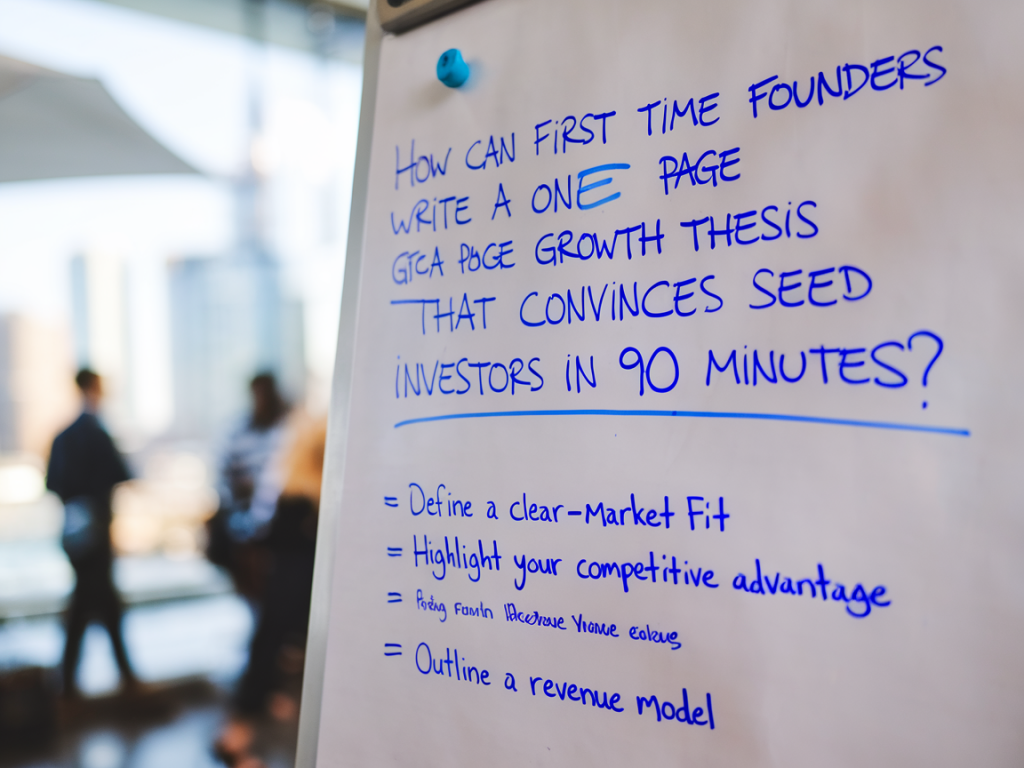
I remember the first time I had to condense my startup’s vision into something investors could actually digest in one sitting. The panic. The endless slide decks. The temptation to cram every possible metric and roadmap into a tiny space. Over time I learned that what seed investors want is not a novella, but a clear, credible argument: a one-page growth thesis that tells them how you will turn an idea into measurable traction and, ultimately, scale.
Here’s how I now coach first-time founders to write a one-page growth thesis that convinces seed investors—in 90 focused minutes. I’ll walk you through a simple structure, the mindset you need, the data to prioritize, and a practical template you can copy, tweak, and use immediately.
Set the right mindset (first 5 minutes)
Before you start writing, I ask founders to do two things: choose a single, specific investor persona and commit to ruthless clarity. Your investor might be an operator who cares about unit economics, or an early-stage VC who bets on teams and market size. Pick one. Then promise yourself you won’t bury the lead—put the hypothesis up front.
What a growth thesis must contain (10 minutes)
A one-page growth thesis needs to answer five core questions, succinctly:
Who are we building for? (target segment & persona)What is the unique value driver? (product/market fit hypothesis)How will we acquire these users? (channels & experiments)How will we monetize and grow unit economics? (pricing & LTV/CAC)What are the key milestones and risks? (metrics & mitigation)These questions become the spine of your page. Each section should be 1–3 sentences and backed by one concrete data point or a realistic assumption.
Minute-by-minute breakdown to finish in 90
Work in three 30-minute sprints: draft, validate, polish.
Sprint 1 – Draft (0–30 minutes): Fill the five core sections with your clearest statements and one supporting metric per section. Don’t over-research—use what you already know or can calculate quickly (e.g., TAM/SAM, conversion from a pilot, CAC from an early campaign).Sprint 2 – Validate (30–60 minutes): Quick fact-checks. Pull one supporting reference per claim: a benchmark from a competitor, a public case study (think: Stripe, Shopify for payments/ecommerce benchmarks), or an internal cohort analysis. If a number is a guess, label it as an assumption with the confidence level (high/medium/low).Sprint 3 – Polish (60–90 minutes): Tighten language, highlight the headline hypothesis in a single sentence at the top, add a small table of key metrics, and create a short risk/mitigation section. Make the page visually scannable: bold the main hypothesis, use short paragraphs, and ensure the investor can read the thesis in under a minute.How to write each section
Below I give the phrasing I use when coaching founders. Copy these sentence starters and fill in the blanks.
Headline hypothesis (1 sentence) — "We will reach X users / $Y revenue by Month Z by focusing on target segment through primary channel, leveraging unique value driver."Target & problem (1–2 sentences) — "We serve specific persona who currently struggle with pain point. This audience represents an accessible segment of the market: TAM/SAM insight or number."Unique value driver (1–2 sentences) — "Our product uniquely delivers benefit via feature/mechanism, proven in our pilot where metric improved by X%."Acquisition strategy (2–3 bullets) — List 2–3 channels with expected conversion funnel and why they’ll scale. Example: "Paid social → landing page → free trial (expected 10% convert to trial, 15% trial-to-paid); initial CAC $40, expected to fall to $20 by optimizing creative and onboarding."Monetization & unit economics (2–3 sentences) — "Average revenue per paying user (ARPPU) $X, gross margin Y%. LTV/CAC today = A/B (or assumed), breakeven payback period = N months."Key metrics & milestones (small table) — Present 3–5 KPIs with current / target at 12 months and rationale (e.g., MRR, DAU, conversion rate, churn).Risks & mitigations (3 bullets) — Identify the top 3 risks and a concrete mitigation for each (e.g., product-market fit: run 5 customer interviews per week; channels not scalable: test two alternatives in parallel).Include a compact metrics table (10 minutes)
Investors love numbers. A tidy table helps them scan your assumptions quickly. Keep it to 3–5 rows: Current, 12-month target, and key assumptions. Use this structure:
| Metric | Now | 12-month target | Key assumption |
| Monthly Active Users (MAU) | 1,200 | 60,000 | Paid acquisition scale + referral loop |
| MRR | $6,000 | $120,000 | Improve conversion to paid from 2% to 6% |
| CAC | $45 | $25 | Optimize creatives + onboarding |
| Gross margin | 55% | 70% | Negotiate supplier costs, add premium plans |
Language: clarity beats bravado
Write with confidence but without hype. Replace phrases like "huge market opportunity" with concrete numbers: "TAM $X, immediate addressable market $Y." If you use comparisons (e.g., "we're like X but for Y"), make them relevant: investors should instantly understand the category and differentiation.
What to avoid
Over-optimistic projections without assumptions labeled.Long product feature lists—focus on the one growth lever that scales.Vague market descriptions—quantify whenever possible.Examples of quick supporting evidence
If you’re short on data, use these quick sources:
Public financials or metrics from comparable startups (Crunchbase, PitchBook summaries).Benchmark reports from Stripe/Shopify/HubSpot for conversion & cohort metrics.Client or pilot metrics—early revenue or retention beats guesses.Final polish tips (last 10 minutes)
Read the page out loud—if a sentence trips you up, simplify it.Highlight the headline hypothesis in bold and place it at the top.Label assumptions and confidence levels; transparency builds trust.Save as PDF too—many investors prefer a one-page PDF attachment.When I teach this to founders, the transformation is immediate. Instead of long-winded narratives, investors can see the thesis, the assumptions, and the plan to de-risk. Write it sharp, back it with one strong table of metrics, and be ready to defend the assumptions. That clarity will make your seed meeting more of a strategic conversation and less of a pitch performance.