Why I focus on three lean experiments (and why you should too)
When I work with early-stage subscription SaaS founders, the same truth keeps coming up: before you hit 1,000 users, your biggest leverage is improving trial-to-paid conversion. Large-scale growth tactics are premature and expensive. What you want are cheap, fast, measurable experiments that move the needle on time-to-value and trust.
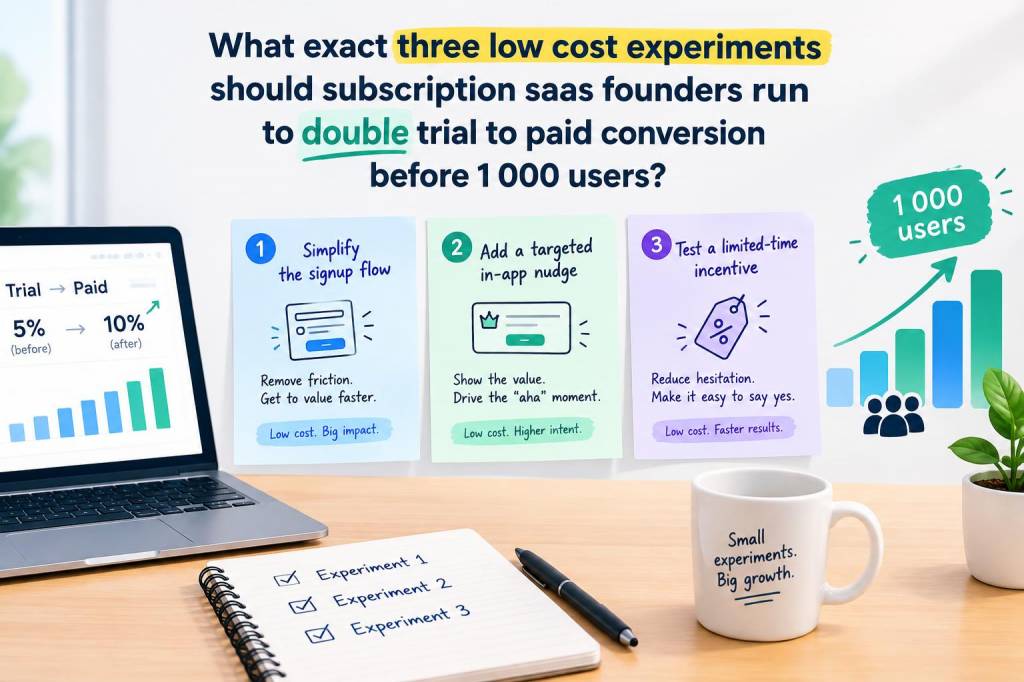
Below I share the exact three low-cost experiments I recommend—and how I run them—so you can double your trial-to-paid conversion before you scale. Each experiment is designed to be inexpensive, fast to implement, and rooted in psychology: reduce friction, increase perceived value, and add a human layer.
Experiment 1 — Radical time-to-value onboarding
Problem: Trials drop off because users don't see value fast enough. The fix is not more screens or more features—it's a focused path to the "aha" moment within the first 24–72 hours.
What I do:
Create a one-path “50% use-case” checklist that guarantees the user experiences a core outcome. Example: For a content planning SaaS, the checklist might be “Create calendar week, add 3 posts, export plan.”Replace a long product tour with an interactive setup that collects the minimum data to produce an immediate result (progressive profiling). Ask only what's essential—company name, one goal, and a data import if needed.Deliver a “first outcome” email + in-app nudge triggered the moment the user completes step 1. The email is micro-focused: “You just created your first X — here’s how to get Y from it.”How to run the experiment (cheap & fast):
Map the existing onboarding funnel and identify the steps before the first meaningful output. Simpler is better.Build the checklist and one-path experience. Use existing onboarding tools (Intercom Product Tours, Appcues trial, or even simple modal workflows you can code in a day).Set the KPI: conversion from trial to paid within 14 days, and secondary KPI: % of users who hit the first outcome within 48 hours.Run for 2–3 weeks or until 200–300 trial users pass through. Compare to your baseline.Why it works: People pay for outcomes more than features. If your onboarding guarantees a mini-success quickly, you drastically reduce decision anxiety.
Experiment 2 — Price framing and plan simplification
Problem: Confusion and perceived lack of fairness are silent conversion killers. Complex tiers and buried pricing give people reasons to delay.
What I do:
Simplify to 2 core plans: “Starter” and “Pro” (or “Personal” and “Team”). Make differences explicit with one-sentence value bullets. Avoid 5 tiers until you have segment size to justify them.Test price framing: anchor with a struck-through "regular" price, show monthly and annual options, and highlight the most popular plan. Use a low-friction discount signal for trial convertors (e.g., “Limited offer: 20% off first year if you upgrade within your trial”).Introduce a micro-commitment upgrade: a low-cost, short-duration add-on (e.g., “One-week Pro trial extension for $1”) for users who need more time.How to run the experiment (cheap & fast):
Create two landing/pricing variations: original vs. simplified + anchored pricing. Use your product's trial modal and website pricing page for A/B testing.Run a test for 2–4 weeks with traffic equally split (or use feature-flagged users to be safer). Measure lift in trial-to-paid conversion and average revenue per converting user (ARPU).If you want to be more surgical, use segmentation: test the micro-commitment offer only on users who engaged heavily but didn't convert by day 7.Why it works: Humans use heuristics. Clear choices reduce cognitive load and nudges like framing and limited-time discounts create urgency without devaluing your product.
Experiment 3 — Founder-led, hyper-personalized outreach
Problem: Automated sequences are necessary but they’re not enough. Early-stage buyers want reassurance and a sense of partnership. A human touch at scale—done selectively—beats large campaigns.
What I do:
Segment trial users into three buckets based on activity by day 5: high-engagement, mid-engagement, and low-engagement.For mid-engagement users, send a personalized email from the founder offering help and a 15-minute onboarding or strategy call. The email must be short, specific, and include a Calendly link or bookable slot.For high-engagement users, offer a quick session to unlock advanced features and show ROI. For low-engagement users, send a short “help me understand” message that asks a single question (e.g., “What's stopping you from seeing value?”).Sample founder email (use table to copy/paste):
| Subject | Quick question about your trial — 15 minutes? |
| Body | Hi [First Name],
I’m Léa. I noticed you’ve been trying [Product] and I’d love to help you get a clear result during your trial. Do you have 15 minutes this week for a quick walkthrough so we can get you to [specific outcome]? Here’s my calendar: [Calendly link].
No pressure—just want to make sure you get value.
—Léa |
How to run this cheaply:
Reserve 2–4 one-hour blocks per week for discovery calls. Use a Calendly link to automate scheduling.Target only users who have shown intent (e.g., 3+ key actions) but haven't upgraded. Keep volume manageable (10–20 calls per month is plenty).Track conversion lifts for users who had a call vs. those who didn't. Use a simple CRM tag or product analytics segment.Why it works: Founder outreach scales psychologically. Founders are perceived as high-trust authorities; a short human interaction resolves objections, accelerates trust, and often converts faster than automated flows.
Metrics to watch and how to interpret them
Every experiment needs clear, simple metrics. I track:
Trial-to-paid conversion rate (14-day and 30-day) — core KPI.Time-to-first-outcome — median hours/days until user completes the onboarding checklist.Activation rate — percent of trials that complete the checklist.Engagement segmentation — percent in low/mid/high buckets.ARPU and churn at 30/60/90 days — ensure conversion lift is not bought at the cost of worse retention.Interpretation tips:
If activation rises but paid conversion does not, you might be delivering the wrong outcome or undervaluing the product post-trial—test messaging and pricing.If founder calls increase conversions dramatically, scale cautiously: hire a customer success rep or document the most common objections and bake answers into onboarding.Quick implementation timeline (one month)
Week 1: Map funnel, build the onboarding checklist, set up tracking, create pricing variation.Week 2: Deploy onboarding + pricing A/B test. Create founder email templates and Calendly slots.Weeks 3–4: Run experiments, hold calls, gather qualitative feedback, and iterate.These three experiments—fast onboarding to the first outcome, simplified price framing, and strategic human touch—are low-cost but high-impact. They play off each other's strengths: onboarding reduces friction, pricing reduces hesitation, and personal outreach resolves final doubts. Implement them in parallel, keep the tests tight, and measure ruthlessly. The results will tell you where to double down next.