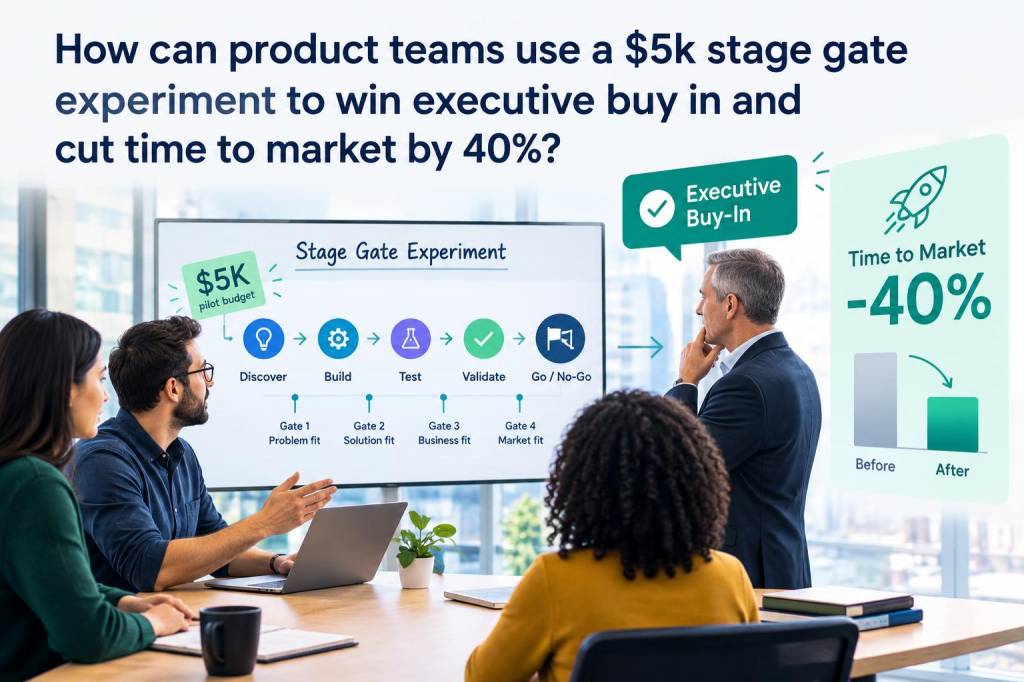
I remember the first time I pitched a bold product idea to executives and watched their eyes glaze over. It wasn’t that the idea was bad — it simply felt risky, vague, and expensive to them. Over the years I learned a pragmatic trick that changed everything for my teams: a focused, low-cost stage-gate experiment — typically under $5,000 — designed to prove value fast, reduce perceived risk, and compress decision cycles. Used well, this approach not only wins executive buy-in but can cut time-to-market by up to 40%.
Why a $5k experiment works
Executives respond to certainty, speed, and risk mitigation. A small, well-framed experiment does three things:
When I design these experiments, my goal is not to fully build the product — it’s to answer the riskiest questions that prevent go/no-go decisions. Is there real customer demand? Will a core feature deliver measurable value? Can we integrate the idea into existing workflows without breaking other priorities?
How I structure a $5k stage-gate experiment
Here’s the practical framework I use. It fits in two to four weeks and keeps costs under $5k for most B2B and digital consumer experiments.
Typical allocations within the $5k budget
This is an example breakdown I often use:
| Item | Est. Cost |
| Paid acquisition (targeted ads) | $1,500 |
| Prototype / development (contractor) | $1,500 |
| Design & copy | $600 |
| Analytics & tooling (short-term) | $300 |
| User incentives / interviews | $600 |
| Buffer | $500 |
These numbers shift by industry (hardware needs different spends), but the principle is the same: allocate funds to the highest-leverage activities that will move your decision metric.
Case example: Cutting time-to-market by 40%
At one company, our product roadmap included a new onboarding flow expected to take six months and $300k to build. Leadership hesitated because the ROI was theoretical. We proposed a $5k experiment: a concierge onboarding process using a simple workflows built with Zapier, Typeform and a lightweight landing page. We targeted 150 new trial signups via LinkedIn and email, routed them through the concierge flow, and measured activation within seven days.
Result: Activation doubled compared to the control, and the conversion effect size met our pre-defined threshold. Because the experiment replicated real-world conditions and used production tools, executives accepted our scaled plan — but with an expedited implementation using our lessons. We reduced project scope, reused the tested flows, and prioritized critical automation pieces. The full program launched in 10 weeks instead of 16 — roughly a 40% reduction in time-to-market.
How to present results to executives
Executives don’t want a novel; they want clarity. I always deliver an executive one-pager and a brief demo. Key elements:
Common pitfalls and how I avoid them
Even small experiments fail when not designed to answer the right question. I watch for:
When a $5k experiment isn’t enough
Not every idea fits the $5k model. Hardware prototypes, deep integration features, or regulatory-heavy products often need more investment. But you can still use the same mindset: reduce uncertainty in the riskiest dimension with a small, targeted test. For hardware, that might be a crowdfunding pre-order page to gauge demand. For regulated products, it might be partnership conversations or pilot programs with a single customer.
How this approach builds leadership trust
Executives value predictable processes. Delivering quick, low-cost experiments that produce clean answers builds a rhythm of evidence-based decision-making. Over time, this pattern shifts conversations from “Is this risky?” to “What experiment can we run next?” That change alone accelerates portfolio velocity and, when combined with the right prioritization, compounds into dramatic reductions in time-to-market.
If you’re ready to implement this in your product organization, start by identifying one project blocked by lack of executive buy-in and design a $5k experiment around the single riskiest assumption. Pack your outcomes into a crisp one-pager, and you’ll be amazed how often the answer shifts from “maybe later” to “let’s move fast.”