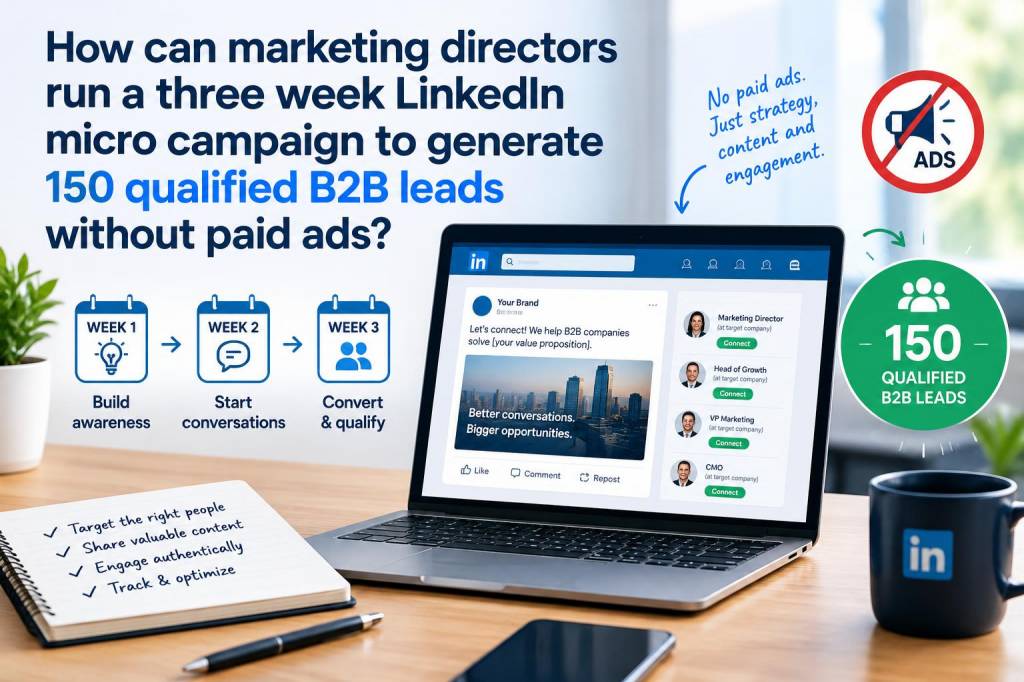
When a marketing director asks me whether it’s possible to run a three-week LinkedIn micro-campaign to generate 150 qualified B2B leads without paid ads, my immediate response is: yes — if you combine precision targeting, high-value content, and disciplined outreach. I’ve run rapid, organic LinkedIn moves that deliver strong pipelines when you treat the platform like a prospecting engine rather than a generic social feed. Below I share a practical, week-by-week blueprint you can execute with a small team (or solo with discipline).
Define “qualified” before you start
First, get crystal clear on what “qualified” means for you. For me, a qualified lead usually meets three criteria: company size (e.g., 50–1,000 employees), role (marketing director/VP, head of digital, CMO), and intent signal (recent hiring, fundraise, product launch, or content engagement). Create a simple qualification checklist and use it to accept or disqualify prospects.
Targeting and list building (Day 1–3)
Precision beats volume. I always start with a sharp ICP (ideal customer profile) and then build lists using LinkedIn Sales Navigator or advanced search. If you don’t have Sales Navigator, you can still use LinkedIn filters plus Boolean keywords.
- Set geographic scope (e.g., UK + EU), verticals (SaaS, FinTech, Healthcare), and company size.
- Search for titles like “Marketing Director”, “Head of Growth”, “VP Marketing”. Include seniority and role variations.
- Export profile links to a Google Sheet (manually or via a scraping tool like Phantombuster if compliant with policy).
Content pillars and value offers (Day 2–4)
For three weeks you need a narrow set of content pillars that demonstrate expertise and encourage interaction. I recommend three pillars:
- Insight: Short posts with actionable frameworks (e.g., 5-step prioritization for demand gen).
- Proof: Case studies or short results posts (e.g., “How we helped X scale lead gen by 42% in 90 days”).
- Interactive: Polls, questions, and invitations to a brief value call or workshop.
Pair each pillar with a micro-offer: a one-page diagnostic, a 15-minute strategy audit, or a 30-minute group workshop. These low-friction offers are the bridge from interest to qualified lead.
Week 1 — Awareness and soft outreach
Goal: create visibility and get warm engagements from target accounts.
- Day 1–2: Publish 3 short posts (one per pillar) timed across the week. Keep them 150–250 words with 1–2 bolded takeaways and a call-to-action (CTA) like “comment your biggest challenge” or “DM me ‘audit’ to get a free 1-pager”.
- Day 3–7: Start connecting with your list. Send highly personalized connection requests — reference a recent post, company news, or mutual connection. Keep it under 300 characters.
- When someone accepts: don’t pitch. Send a thank-you message with a micro-value (a stat, link to the one-pager, or an invite to a 15-minute audit). Track responses in a sheet.
Week 2 — Engage and qualify
Goal: move prospects from connection to engaged conversation.
- Publish 3–4 pieces of content this week, including one short video (30–90 seconds). Video performance on LinkedIn is disproportionately high — record straight to your phone with good lighting and a focused script.
- Leveraged content tactic: tag 4–6 prospects in a comment where the post is directly relevant to them (only when it genuinely fits). This sparks notifications and opens doors for dialogue.
- Begin a light outreach cadence to new connections who engaged but didn’t respond. Example sequence:
- Message 1 (day 1 after connect): Thank you + one insight or resource.
- Message 2 (day 4): Ask a contextual question about a challenge you’ve seen in their sector.
- Message 3 (day 7): Invite to a brief audit or workshop with limited seats.
- Qualify during chat: ask two discovery questions (budget/decision timeline + biggest priority). If they fit, propose a booking link for a 15-minute call.
Week 3 — Convert and escalate
Goal: convert interested prospects into booked meetings and fast-track high-intent leads.
- Host a live 30-minute mini-workshop or Q&A mid-week and invite connections who engaged. Use Zoom or LinkedIn Live. The scarcity and practical format increases conversion.
- Follow up with attendees: send the workshop recording plus a 1-click calendar invite for a free 15-minute strategic audit.
- For warm prospects who requested resources, escalate to a discovery call. Use a qualification script to ensure fit and book next-step meetings for your sales or consulting team.
- Keep publishing lightweight social proof posts (screenshots, short testimonials) to maintain momentum and social validation.
Operational playbook and tools
Execution speed matters. Here’s what I use to run this playbook quickly:
- LinkedIn (personal profile + pages) — primary channel.
- LinkedIn Sales Navigator — for targeted lists and saved searches.
- Canva — for branded visuals and short video thumbnails.
- Calendly or HubSpot Meetings — for instant booking links.
- Google Sheets — campaign tracker with columns: name, company, title, connection date, engagement, qualification score, next action.
- Zapier — to push form signups or event attendees into Sheets or CRM automatically.
Measurement and KPI table
| Metric | Target (3 weeks) | Why it matters |
|---|---|---|
| Connections invited | 1,500–2,000 | High volume increases chance of hitting 150 qualified leads |
| Connection acceptance rate | 20–35% | Good targeting and personalization drive higher acceptance |
| Engaged prospects (comment/DM) | 300–450 | These are your warm pool for qualification |
| Qualified leads | 150+ | Matches your ICP and show buying intent |
| Booked meetings | 30–60 | Turning leads into pipeline |
Message templates that convert
Short templates I use (personalize every line):
- Connection request: “Hi [Name], I noticed your recent piece on [topic] and I loved the perspective. I work with marketing teams in [sector] on growth strategy — would love to connect.”
- Post-accept message: “Thanks for connecting, [Name]. Quick question — are you currently prioritizing demand gen or product-led growth this quarter? I’ve got a 1-page checklist that helps decide.”
- Follow-up to engaged commenter: “Appreciate your comment on my post — you mentioned [pain]. If you’re open, I can run a 15-minute audit to map quick wins.”
Scaling and common pitfalls
You can scale by adding outreach teammates or rotating content authors, but avoid these traps I see often:
- Over-automation: robotic messages kill acceptance rates.
- Poor follow-up: lead momentum is fragile — follow up within 48 hours.
- Too broad targeting: you’ll waste time on mismatches. Refine filters daily.
If you follow this plan with discipline — daily content, personalized connections, value-led messaging, and a fast qualification rhythm — a three-week micro-campaign can absolutely generate 150 qualified B2B leads organically. The secret is sustained, targeted effort and offers that make it easy for prospects to say “yes” to the next step.