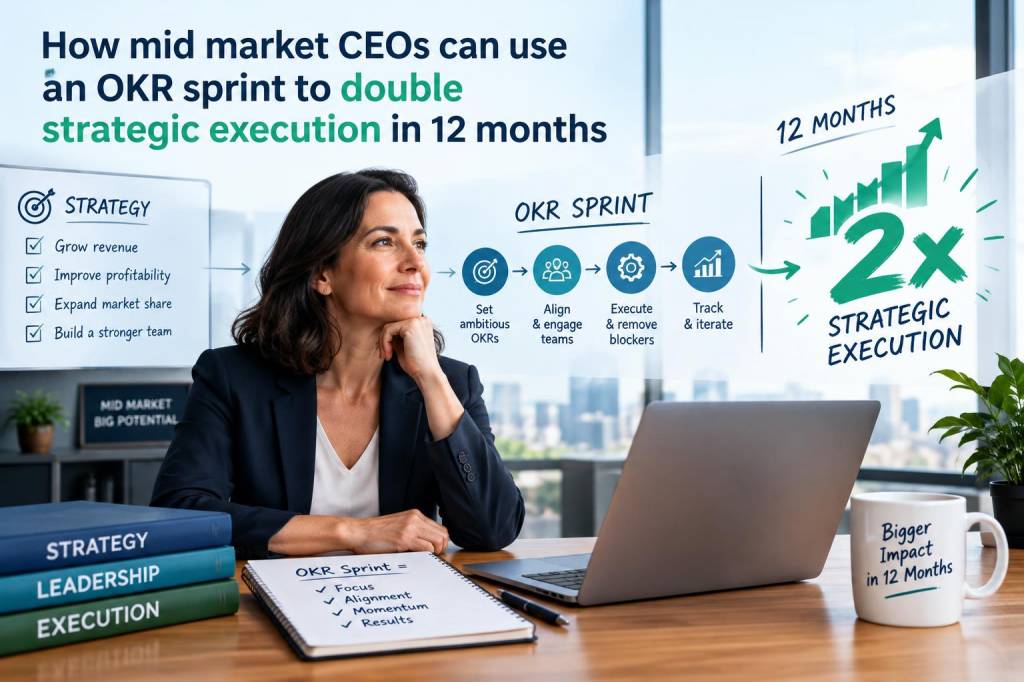
I have seen too many mid-market companies fall into a familiar pattern: ambitious strategy decks, energetic offsites, and a long list of priorities that slowly lose shape once daily operations take over. A leadership team may leave a planning session feeling aligned, yet six months later, progress is scattered, accountability is fuzzy, and important initiatives move far more slowly than expected. That is exactly why I value an OKR sprint. When used with discipline, it can help a CEO sharpen focus, create visible ownership, and double strategic execution within twelve months.
In my experience, the problem is rarely a lack of intelligence or effort. It is usually a lack of a shared operating rhythm. Mid-market CEOs often lead businesses that are complex enough to need structure, but still nimble enough to move quickly if everyone pulls in the same direction. An OKR sprint gives that structure without turning the company into a bureaucratic machine. It forces clarity on what matters, what will be ignored, and what proof of progress will look like.
Why an OKR sprint works for mid-market companies
I like OKRs because they are brutally practical when used well. A good Objective tells everyone where we are going. Good Key Results tell everyone what success will look like in measurable terms. A sprint adds urgency. Instead of treating OKRs like a once-a-year planning exercise, I use a sprint format to compress learning, remove confusion, and keep execution moving at a pace the business can sustain.
Mid-market companies benefit from this approach because they often face a specific tension: they are large enough to need alignment across functions, yet small enough that one misaligned team can create major drag. Sales, marketing, operations, finance, and product may all be working hard, but without a single execution rhythm, effort gets diluted. An OKR sprint reduces that friction by creating a shared cadence of focus, review, and adjustment.
What I find most powerful is that a sprint makes strategy visible. Instead of saying, “We want growth,” I can say, “We will increase qualified pipeline by 30%, reduce onboarding time by 20%, and improve customer retention by 8% in this quarter.” That level of precision changes behavior immediately. Leaders stop talking in abstractions and start solving real problems.
What I mean by a strategic execution sprint
When I talk about an OKR sprint, I am not describing a software feature or a trendy management ritual. I mean a focused cycle, usually thirty to ninety days, in which leadership commits to a small number of strategic outcomes, assigns clear owners, and reviews progress frequently enough to intervene early. The sprint becomes a testing ground for strategic priorities.
For a mid-market CEO, the goal is not to launch more initiatives. It is to increase the conversion of strategy into action. That means fewer priorities, clearer metrics, and tighter feedback loops. I have found that when a leadership team can sustain this discipline over four quarters, execution capacity changes dramatically. Decisions become faster. Dependencies become visible sooner. Teams spend less time guessing what matters.
One reason this approach works so well is that it discourages strategic clutter. Many companies overload their annual plans with too many objectives, each one important enough to deserve attention, yet none strong enough to drive real momentum. A sprint forces selection. If something is not essential, it does not enter the cycle.
The leadership habits I ask a CEO to build
I never treat OKRs as a paperwork exercise. They only work if leadership behavior changes. When I work through this framework, I ask the CEO to model a few habits that shape the entire organization:
- Choose fewer priorities. Three company-level objectives are usually enough for a sprint.
- Define success in measurable terms. If a result cannot be tracked, it is not ready.
- Assign one owner per outcome. Shared ownership often means no ownership.
- Review progress weekly. Monthly reviews are often too slow for real course correction.
- Remove obstacles quickly. The CEO should solve blockers, not just observe them.
- Reward learning, not just wins. A sprint should reveal what works and what does not.
These habits matter because strategy execution is emotional as well as operational. People watch what the CEO pays attention to. If leadership treats OKRs as optional, the rest of the company will too. If leadership treats them as the central operating system for execution, the organization responds with far more discipline.
What a strong OKR sprint looks like in practice
When I help leaders design a sprint, I start by asking three questions: Where are we trying to win? What must change in the next ninety days? What is the smallest set of measurable outcomes that would prove momentum? Those questions usually cut through noise very quickly.
For example, a company may identify a growth objective and support it with key results such as:
- Increase conversion from qualified lead to closed deal from 18% to 24%
- Reduce average sales cycle from 72 days to 55 days
- Launch two partner channels that contribute at least 15% of new pipeline
That kind of structure gives marketing, sales, and leadership a common language. It also prevents one team from declaring victory while another team quietly absorbs the cost. I have seen this alignment reduce internal frustration almost immediately, because everyone knows what they are working toward and why it matters.
The sprint rhythm matters as much as the OKRs themselves. I prefer a weekly leadership checkpoint with a simple structure: progress, risks, decisions, and support needed. That meeting should be short, factual, and brutally honest. I do not want status theater. I want signal. If something is off track, we surface it early. If a metric is improving, we learn what is driving it. If a team is stuck, we clear the path.
| Execution area | Weak pattern | Strong sprint behavior |
|---|---|---|
| Priority setting | Many objectives, vague ambition | Few objectives, sharp focus |
| Accountability | Shared responsibility without clear ownership | One owner per key result |
| Review cadence | Monthly updates with little correction | Weekly reviews with fast decisions |
| Leadership behavior | Passive monitoring | Active problem removal |
| Results | Slow drift and inconsistent follow-through | Visible momentum and faster delivery |
Where CEOs usually get stuck
I have noticed a few recurring traps. One is overloading the sprint with too many metrics. A dashboard can become an excuse for inaction if no one knows which numbers truly matter. Another is selecting outcomes that are too easy to influence indirectly. I want key results that are close enough to execution to be useful, not just numbers that look good in a board slide.
A second trap is confusing activity with progress. A team can produce many meetings, reports, and task lists without creating any strategic movement. An OKR sprint should force a more uncomfortable question: did we actually change the business? If the answer is no, the sprint has not done its job.
A third trap is inconsistent leadership follow-through. If a CEO misses reviews, tolerates ambiguity, or changes priorities every few weeks, the sprint loses credibility. I believe consistency matters more than complexity. Even a simple OKR system can transform execution if it is used with discipline.
There is also a cultural risk. Some employees may fear that OKRs are simply a new way to judge them more harshly. I think the CEO must address that directly. The point is not punishment. The point is clarity. People generally welcome structure when it helps them succeed and removes confusion from their work.
How I would use a twelve-month sprint cycle
If my goal were to double strategic execution in twelve months, I would break the year into four linked sprints. Each sprint would have its own objectives, but all of them would support a broader annual direction. That balance matters. A sprint without an annual theme becomes tactical noise. An annual strategy without sprint discipline becomes wishful thinking.
In quarter one, I would focus on alignment and selection. The organization would decide what truly matters and build confidence in the new cadence. In quarter two, I would aim for visible execution discipline, with faster reviews and better ownership. In quarter three, I would use the learning from earlier cycles to refine priorities and remove friction. In quarter four, I would push for scale, consistency, and stronger cross-functional coordination.
That sequence creates a compounding effect. Each sprint improves the next one. The company does not just complete more projects; it becomes better at deciding, prioritizing, and delivering. That is what I mean by doubling strategic execution. It is not merely faster activity. It is a stronger conversion of strategy into measurable business movement.
I also think leaders should track a small set of execution health signals alongside commercial metrics. These may include cycle time, decision turnaround, cross-functional dependency resolution, and the percentage of key results on track by the midpoint of each sprint. These signals tell me whether the organization is getting stronger at execution, not just temporarily hitting targets.
Questions I ask before starting an OKR sprint
- Are we willing to say no to nonessential work?
- Do we have one accountable owner for each outcome?
- Can we measure progress weekly, not just quarterly?
- Will senior leaders actively remove blockers?
- Are our objectives linked to real business pressure, not vanity metrics?
- Do teams understand why these outcomes matter now?
When I can answer yes to most of those questions, I know the company is ready to use a sprint seriously. When I cannot, I know the issue is not the framework. The issue is leadership readiness.
What I appreciate most about an OKR sprint is its honesty. It exposes whether a company can truly focus, coordinate, and execute under pressure. For a mid-market CEO, that exposure is valuable. It creates a clearer view of what is working, where energy is leaking, and which priorities deserve more attention. In a market where speed and discipline both matter, that kind of clarity can become a serious advantage.