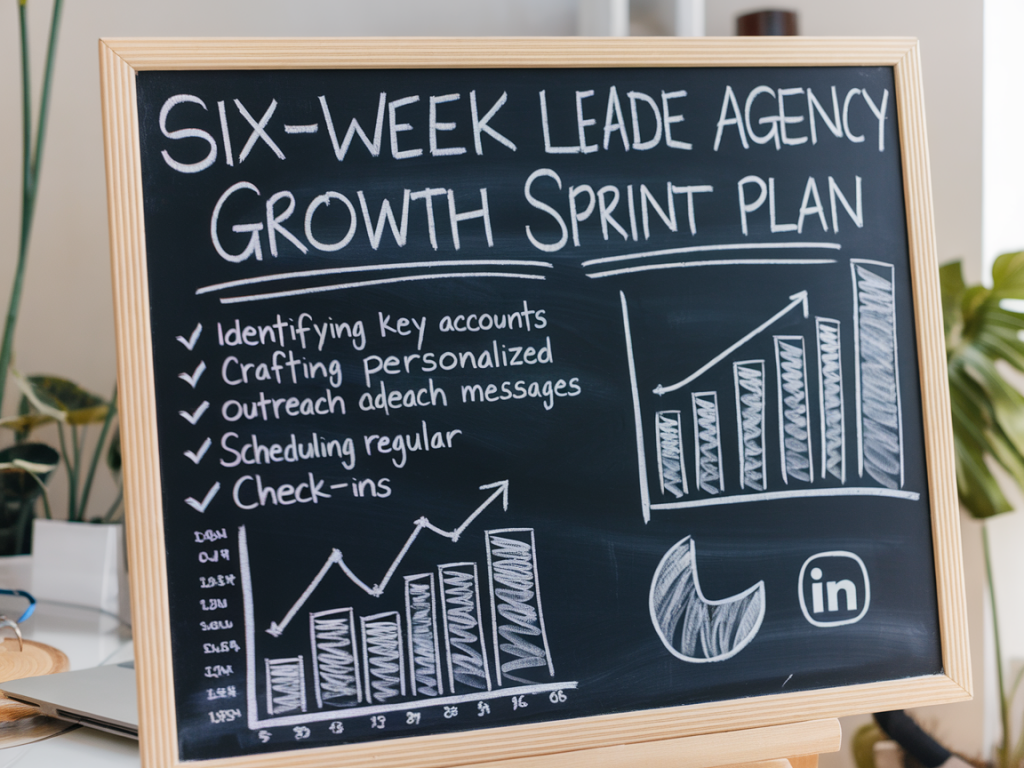
I’m going to walk you through a practical, six-week growth sprint I run at Leader Agency when the goal is clear: increase qualified B2B leads on LinkedIn by 30%. This is a hands-on, measurable approach that combines profiling, content, outreach, and conversion optimization. I’ve tested iterations of this with clients and my own initiatives, and the framework below is what consistently moves the needle.
Start with a crisp hypothesis and baseline
Every sprint begins with a hypothesis. Mine usually looks like this: "By optimizing our LinkedIn targeting, messaging, and content cadence, we can lift qualified inbound and outbound lead flow by 30% in six weeks." Before you do anything, establish a baseline. Export the last 90 days of LinkedIn leads and conversions (or CRM records) and record:
- Number of leads sourced from LinkedIn
- Number of qualified leads (MQLs/SQLs depending on your process)
- Conversion rate from lead to qualified
- Average response rate to LinkedIn outreach
- Content engagement rates (views, likes, comments, shares)
Document these in a simple spreadsheet — this will be your north star for measuring the 30% uplift.
Week-by-week sprint roadmap
I split the six weeks into discovery & setup, activation, optimization, and scale phases. Below is the cadence I follow.
Week 1 — Profile & ICP surgical work
The killer mistake most teams make is targeting too broadly. I spend week 1 refining the Ideal Customer Profile (ICP) and optimizing outward-facing assets.
- Run a 1:1 with sales to define top 3 ICP segments (company size, role, vertical, tech stack, trigger events).
- Audit LinkedIn profiles of the outbound team and company page. Make sure headlines are benefit-driven (not just job titles). Example headline: "I help SaaS CEOs reduce churn by 15% through growth operations".
- Update company page banner, description, and services. Add case study links and a clear CTA to a lead magnet or booking link.
- Set up tracking: UTM templates, CRM lead source mapping, and a dashboard (Google Sheets or HubSpot).
Week 2 — Content pillars & lead magnets
Content should work for both inbound discovery and outbound touchpoints. I build 3 content pillars aligned to the ICP pain points:
- Growth & GTM strategies for scaling teams
- Practical marketing playbooks (LinkedIn ads, ABM, content ops)
- Leadership & operational frameworks for decision-makers
For each pillar, create a lead magnet that’s short and practical: a one-page audit checklist, a 10-minute video, or a template (e.g., "SaaS GTM Week-90 Plan"). I publish the content in these formats:
- Long-form LinkedIn article (1 per pillar)
- 3-4 short posts (text + image/carousel) per week
- 1 outbound message thread that references the lead magnet
Week 3 — Targeted outbound sequences
Now we build sequences that feel human. Instead of spray-and-pray, I use 3-step sequences tailored to each ICP.
- Connection request: 2-line personalised note referencing a mutual connection/insight. Example: "Hi [Name], noticed your work at [Company]. I helped a similar team cut CAC by 20% and would love to connect."
- Value message: Share the lead magnet or a specific stat that matches their role (no pitch). Include a soft CTA: "Would this be useful for your Q2 planning?"
- Follow-up: Share a client snippet or brief case study with a clear calendar link for those who engage.
Tools I use: LinkedIn Sales Navigator for precise lists, a sequence tool like Expandi or Dux-Soup (or Apollo/HubSpot sequences), and PhantomBuster for scaling safe connection requests. Always respect LinkedIn limits and prioritize quality over quantity.
Week 4 — Amplify social proof & syndication
By week 4, early signals tell you what’s resonating. I amplify social proof and repurpose high-performing assets:
- Turn a top-performing post into a short video or carousel
- Pin a client case study or testimonial to my profile
- Send a micro-newsletter via LinkedIn or email to engaged prospects (digest of insights + CTA)
- A/B test two CTAs: "Download checklist" vs "Book 15-min review"
This is also when I ask sales to prioritize warm responders and log outcomes immediately in the CRM so attribution stays accurate.
Week 5 — Qualification & discovery optimization
We focus on improving lead-to-qualified conversion. I create a short qualification script for any inbound and tweak my outreach to ask one crucial qualifying question early (e.g., "Is this something you’re looking to solve this quarter?").
- Train SDRs on the follow-up playbook and objection responses
- Implement a lead scoring tweak: increase weight for specific triggers (funding, headcount growth, tech stack)
- Use short, automated booking flows (Calendly with pre-call form) to capture context
Week 6 — Scale & measure
In the final week I scale the winners and measure everything. I increase outreach volume for the top-performing ICPs and content types while keeping message personalization templates ready. I also prepare a sprint report that answers: did we hit +30% qualified leads? Why or why not?
KPIs and tracking table
Here’s the simple table I use daily to track sprint progress. Copy it into your sheet and update every 48 hours.
| Metric | Baseline (90d avg) | Current | Target (+30%) | Notes |
|---|---|---|---|---|
| LinkedIn leads | e.g., 50 | e.g., 62 | 65 | Inbound + outbound |
| Qualified leads (MQL/SQL) | e.g., 15 | e.g., 20 | 19.5 | Focus on qualification script |
| Response rate to outreach | e.g., 8% | e.g., 12% | 10.4% | Personalization increased |
| Content engagement | e.g., 250 avg | e.g., 600 | 325 | Experiment with carousels |
Common obstacles and how I handle them
Here are pitfalls I repeatedly see and the quick remedies I apply:
- Low profile conversion: Fix headline and pinned content. Use social proof immediately in the intro message.
- Sequence fatigue: Shorten messages and include a value-first step (free audit, checklist).
- Poor attribution: Force-tag every campaign with UTMs and require SDRs to select a lead source on the first touch.
- Too broad targeting: Narrow ICP, then apply exclusions (e.g., avoid consulting agencies if you sell to product-led SaaS).
Templates I use (short & adaptable)
Here are two battle-tested message templates you can personalize quickly.
- Connection request: "Hi [Name], I enjoyed your recent post on [topic]. I work with SaaS teams to improve activation and would love to connect and share a quick checklist that may help."
- Value follow-up: "Thanks for connecting, [Name]. I put together a 1-page GTM sprint checklist for scaling SaaS teams — would that be useful for your Q2 planning? If yes, I’ll send it over."
Throughout the sprint I keep a weekly retrospective: wins, losses, and one change to implement next week. That continuous improvement loop is what turns a one-off uplift into a repeatable system that sustainably increases qualified B2B leads from LinkedIn.