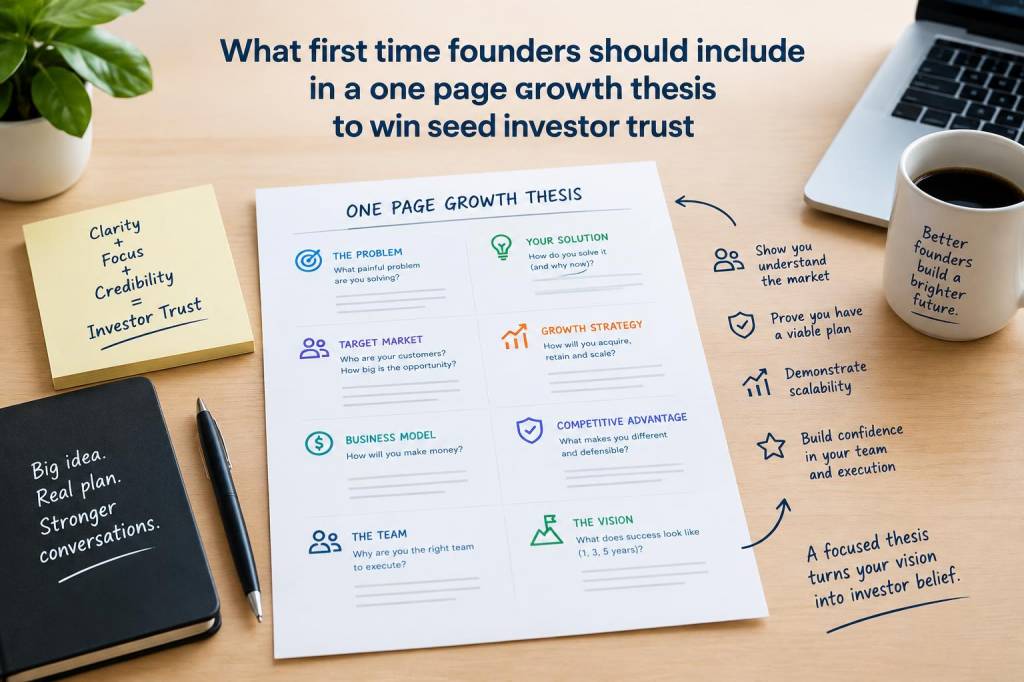
When I speak with first-time founders, I often notice the same tension: they want a growth story that feels ambitious, but they also want it to sound credible enough for a seed investor to believe it. That balance matters more than many people realize. A one-page growth thesis is not a polished brochure. It is a decision tool. It should help an investor understand why your company can grow, where that growth comes from, and why you are the right person to make it happen.
I have seen founders lose investor trust not because their ideas were weak, but because their growth story was vague, inflated, or disconnected from reality. I have also seen early teams win trust with a simple, disciplined page that showed clear thinking, real market awareness, and a believable path forward. That is what I want to focus on here: what I believe a first-time founder should include in a one-page growth thesis if the goal is to win seed investor trust.
Start with a sharp problem statement
Before I think about channels, revenue, or scaling, I want to know whether you truly understand what problem exists, who has it, and why it matters now. Seed investors do not expect perfection, but they do expect clarity. If your opening paragraph sounds broad or generic, trust begins to weaken immediately.
I like to see a problem statement that answers three questions in plain language:
A strong problem statement should feel specific enough that someone can picture a real customer. For example, I trust a founder more when they say, “Small e-commerce brands lose margin because ad spend is rising faster than their ability to measure retention,” than when they say, “Businesses need better marketing solutions.” Specificity signals focus, and focus is one of the first signs of founder maturity.
Explain why growth is possible now
I always want to know why this moment is favorable. A great growth thesis is not only about product strength; it is about timing. Something in the market, technology, regulation, or customer behavior should be making this opportunity more reachable now than it was two years ago.
This part does not need dramatic language. In fact, I trust it more when it sounds grounded. You might point to cheaper distribution, a shift in buyer behavior, rising labor costs, a new software capability, or an underserved niche that has become easier to reach. What matters is that your thesis explains why now in a way that feels credible.
When I read this section, I ask myself whether the founder is surfacing a real market shift or simply trying to create urgency. Investors can tell the difference. If your timing argument is weak, your entire growth case can feel like wishful thinking.
Show a believable route to first traction
One of the biggest mistakes I see is founders jumping straight from “big opportunity” to “massive scale.” That leap is too wide. A seed investor wants to see the bridge between idea and traction. In a one-page thesis, I want a clean explanation of how the company will get its first meaningful customers, not a fantasy of instant breakout.
I usually look for a short description of the first acquisition path. That could be outbound sales, content, partnerships, community, product-led growth, or a narrow paid acquisition motion. What matters is not choosing a trendy channel. What matters is choosing a channel that matches the buyer, the budget, and the product cycle.
For me, credibility rises when a founder explains:
If you cannot explain your first traction path in a page, investors may worry that you have not done enough market work yet. A growth thesis should make your early motion feel deliberate, not random.
Include one clear growth engine, not five vague ideas
First-time founders often feel pressure to sound resourceful, so they list every possible growth lever at once. I understand that instinct, but it usually weakens trust. A one-page growth thesis should highlight one primary engine, maybe two at most, with enough detail to show conviction.
I prefer a thesis that says, in effect, “This company grows because this specific motion compounds over time.” That could mean referrals, organic search, sales efficiency, network effects, or high retention feeding expansion revenue. If you try to cover everything, nothing stands out.
When I review this part, I want to know:
A founder who can answer those questions sounds like someone who understands mechanics, not just ambition. That is exactly what seed investors are looking for.
Make your numbers simple and honest
I do not need a giant spreadsheet in a one-page thesis, but I do need numbers that feel grounded. Seed investors are not just buying vision. They are buying your ability to think in evidence. A few well-chosen metrics can do more for trust than a long list of optimistic projections.
I like to see a small set of assumptions that connect directly to growth. For example:
What matters is not that every number is perfect. What matters is that the logic hangs together. If your business needs a long sales cycle but your thesis assumes fast revenue acceleration, investors will notice. If you claim a low acquisition cost but do not explain the channel, they will also notice.
I trust founders more when they show a willingness to name uncertainty. A simple phrase like “We expect early variation here, but we believe this range is realistic based on comparable products” goes a long way. Honesty is often more persuasive than overconfidence.
Prove you understand customer behavior
Growth is not only a distribution problem. It is a behavior problem. I want to know why customers will switch, stay, and recommend. If your thesis ignores behavior, it may sound neat but still fail in practice.
When I write or review a growth thesis, I think about the customer journey from first awareness to repeat use. Where does urgency come from? What triggers purchase? What creates habit? What drives retention? What turns one user into many?
Here, a founder should speak in customer language, not investor jargon. I respond better to statements like “buyers adopt after a painful manual process becomes too costly” than to abstract claims like “we create value through ecosystem synergy.” Clear behavioral insight signals that you have spent real time with users.
State your unfair advantage carefully
Every founder wants to talk about moat, and I think that is fair. But early-stage moat language can become misleading if it is too grand too soon. On a one-page thesis, I want a modest but believable answer to this question: why will this team win this niche before others can?
Your advantage might come from distribution access, domain expertise, proprietary data, workflow intimacy, brand trust, or speed of iteration. It does not need to be dramatic. It does need to be real.
For me, a useful way to frame this is:
I am cautious when founders overstate defensibility too early. A seed investor is usually more impressed by a clear path to advantage than by a claim that you already have one.
Show what you will measure in the next twelve months
I always want to know what success will look like in practice. A one-page growth thesis becomes much more convincing when it names the few metrics that matter most over the next year. This tells me you are managing toward evidence, not hoping for momentum.
The metrics should fit your business model. For one company, I may care most about qualified pipeline and close rate. For another, I may care about activation, retention, and expansion. What matters is that the metrics map directly to the growth engine you described earlier.
| Growth element | What I want to see | Why it builds trust |
|---|---|---|
| Problem statement | Specific customer pain with real urgency | Shows market clarity |
| Timing argument | Reason growth is possible now | Shows strategic awareness |
| Early traction path | Clear channel and first buyer segment | Shows execution discipline |
| Growth engine | One repeatable compounding motion | Shows scalability |
| Metrics | Few numbers tied to real progress | Shows accountability |
Write with conviction, but leave room for learning
One thing I have learned is that seed investors trust founders who sound decisive without sounding rigid. A one-page thesis should reflect conviction, but it should not pretend the market has already been solved. That balance matters, especially for first-time founders.
I appreciate language that shows confidence in the direction and humility about the unknowns. For example, I trust “We believe this segment offers the fastest path to repeatable revenue, and we will refine the message as we collect more customer data” much more than “We have already identified every variable.” The first statement sounds like leadership. The second sounds unrealistic.
A great thesis leaves room for adjustment while still showing a strong point of view. That is a rare and powerful combination.
Keep it readable enough for a busy investor
If I can offer one practical observation, it is this: your one-page thesis should be easy to skim without losing meaning. Seed investors read quickly. A document that is visually cluttered or intellectually dense can hide a good idea.
I prefer short sections, direct language, and a structure that moves from problem to timing to traction to scale. If I can understand the story in one pass, I am more likely to keep reading and more likely to remember the founder later.
For me, trust grows when a founder respects my time. A clear, concise page suggests the same discipline they will hopefully bring to hiring, product choices, and capital allocation.