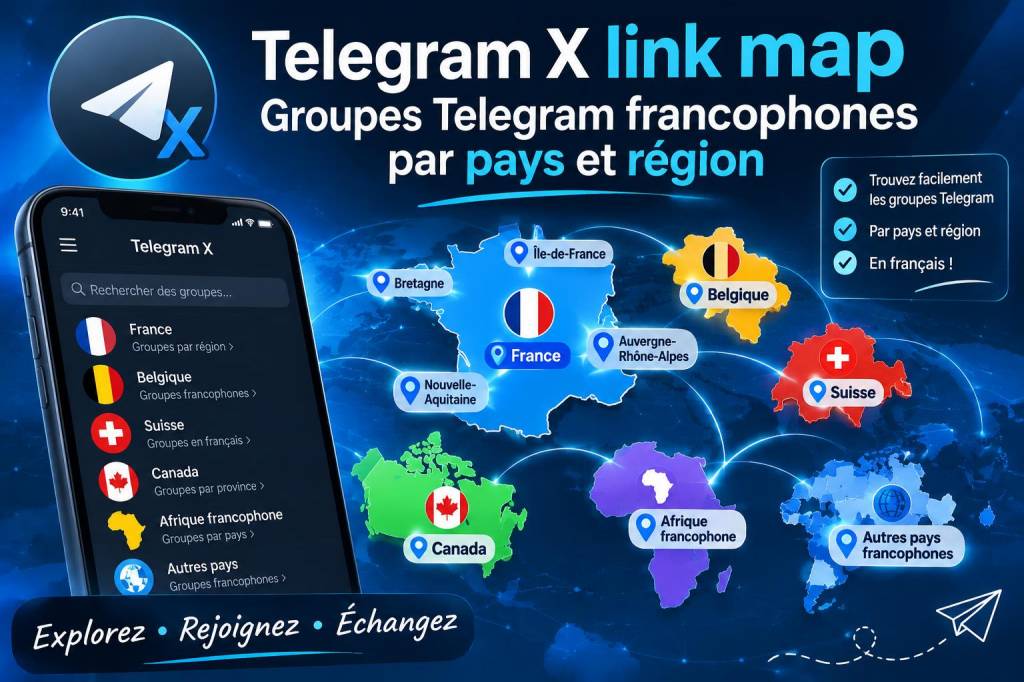
I keep seeing people search for organized Telegram spaces by country, city, and community size, and I understand why. When a platform grows fast, users want a clean way to map active communities without wasting time on dead links or noisy rooms. That is why I focus on groupes Telegram francophones par pays et région, because a structured view changes everything: discovery becomes faster, trust becomes easier, and audience intent becomes much clearer.
From a marketing perspective, this subject is more than a directory idea. It is a distribution map. It shows where conversations happen, which local communities are active, and which countries or regions are producing real engagement. When I think like a strategist, I do not see a list of chats; I see segmentation, community behavior, and audience channels that can support brand awareness, recruitment, local commerce, and creator growth.
Why I treat Telegram maps as a serious marketing asset
Telegram is not just another messaging app. It has become a high-density communication layer for communities that want speed, privacy, and direct access. According to Telegram’s public claims, the platform surpassed 900 million monthly active users in 2024, which makes it large enough to matter in any serious audience strategy. When a channel or group is organized by country or region, I can infer language preference, local interest, and cultural context much more accurately than with broad social feeds.
That matters for brands and publishers because community data is often more actionable than platform vanity metrics. A group of 2,000 people in France does not behave like a group of 2,000 people spread across francophone Africa. Even if the language is similar, the needs, timing, purchasing power, and information appetite can differ sharply.
When I examine groupes Telegram francophones par pays et région, I am really looking for patterns such as:
- Local demand signals
- Regional trust clusters
- Country-specific moderation styles
- Cross-border audience overlap
- Potential partnership and affiliate channels
What a useful map should contain
A useful Telegram link map should do more than collect links. I expect it to separate communities by geography, language intensity, subject category, and activity level. Without that structure, the archive becomes hard to trust.
In practical terms, I look for these elements in a strong map:
- Country tags such as France, Morocco, Democratic Republic of the Congo, and Congo
- City or region tags such as Paris, Casablanca, Kinshasa, Douala, Abidjan, or regional labels
- Clear group purpose such as business, jobs, study, entertainment, local news, or mutual aid
- Entry status such as public, private, invite-only, or moderated access
- Activity markers such as daily posting, weekly posting, or dormant status
I also pay attention to whether the map shows channels, groups, or both. Telegram channels are ideal for broadcasting, while groups are better for interaction. In marketing, that difference is critical. A channel can scale a message. A group can reveal response quality.
France, Morocco, Congo, and Kinshasa: why these clusters matter
Some locations appear again and again because they sit at the center of strong francophone digital behavior. France remains a major content and commerce market, with high digital adoption and strong community segmentation. Morocco often combines French usage with local commerce, diaspora links, and youth-led digital activity. Kinshasa stands out because of its population scale, linguistic reach, and highly social mobile culture. The wider Congo region also matters because local community exchanges often travel through Telegram faster than through formal media.
I find these clusters useful for different reasons:
- France: strong for brand campaigns, niche communities, and professional topics
- Morocco: valuable for bilingual audiences, local services, and youth communities
- Kinshasa: powerful for mass participation, social sharing, and informal commerce
- Congo: useful for regional ties, diaspora connections, and local information flow
In every case, the point is not simply where the group is located. The point is how the community behaves. A well-mapped Telegram ecosystem allows me to compare engagement style across markets rather than assuming all francophone users behave the same way.
My practical criteria for evaluating a Telegram group
When I assess a group, I use a checklist that blends editorial judgment and marketing logic. I do not trust raw member count alone. A large group can still be low quality if it is inactive, spam-heavy, or poorly moderated.
Here is the method I rely on:
- Posting rhythm: Is the room active enough to matter?
- Content quality: Are posts relevant, or just repetitive noise?
- Language fit: Is the francophone audience truly central?
- Moderation level: Are spam and scams kept under control?
- Audience coherence: Does the country or region tag match the conversation?
- Traffic value: Does the community have potential referral or conversion value?
This is where Telegram becomes interesting for marketers. A high-quality group can reveal customer questions before they appear in search data. It can also show which headlines, offers, or topics are gaining traction in a specific region.
Numbers I pay attention to when I read community data
I prefer measurable signals, not vague impressions. When I work with communities like these, I pay attention to a few core metrics:
| Signal | Why I care | What it can reveal |
|---|---|---|
| Member count | Shows scale | Market size and reach potential |
| Daily message volume | Shows liveliness | Real participation, not dead membership |
| Response speed | Shows urgency | How quickly people react to issues or offers |
| Link clicks | Shows intent | Interest in external resources or products |
| Moderation strictness | Shows quality control | Risk level and community trust |
Telegram itself publishes periodic platform milestones, while third-party analytics firms frequently estimate channel and bot growth across messaging ecosystems. In my view, the exact number matters less than the direction: messaging communities continue to expand, and localized francophone clusters remain commercially useful.
Why a country-and-region map helps content strategy
I often use geographic mapping as a starting point for content planning. If I know a community is centered in Kinshasa, I can adapt tone, timing, and examples. If a group is concentrated in France, I may lean into different references, schedules, or business use cases. If Morocco is prominent, I consider how bilingual habits and local digital behavior affect interaction.
That level of precision helps in several ways:
- Audience segmentation becomes sharper
- Editorial planning becomes more relevant
- Ad placement becomes easier to justify
- Partnership outreach becomes less random
- Community trust improves when content feels local
For Leader Agency, this fits naturally into a marketing lens. Community maps are not only directories; they are insight engines. They tell me where attention lives and how I might earn it without wasting effort.
Risks I watch for before sharing a Telegram link map
I never recommend a Telegram resource without checking the risks around it. Some groups are overrun by spam, fake offers, or repeated reposts. Others are technically public but practically unusable. A polished map should warn readers about these issues instead of pretending every link is equally valuable.
The main risks I watch for are:
- Scam promotion disguised as community conversation
- Inactive rooms that no longer reflect current traffic
- Misleading labels where a country tag does not match the audience
- Privacy concerns in invite-only or semi-private spaces
- Content duplication across multiple mirrored groups
For that reason, I prefer maps that are curated rather than random. Curation saves time, reduces risk, and improves editorial confidence.
Sources I rely on when I validate community trends
When I want to cross-check what I see inside Telegram ecosystems, I compare platform data with broader digital reports. Three sources I consider useful are:
- Telegram official website and platform updates: telegram.org
- DataReportal digital reports for country-level internet and social usage: datareportal.com
- We Are Social and Meltwater annual digital reports for regional behavior patterns: wearesocial.com
These sources do not replace direct observation, but they help me avoid drawing conclusions from a single community snapshot. A solid map should combine platform evidence with broader digital context.
A simple framework I use before joining or promoting a group
Before I join, save, or recommend any community, I test it against a short framework. This keeps me focused on utility rather than hype.
- Does the group have a clear country or regional identity?
- Is the language consistent with a francophone audience?
- Does the activity feel organic?
- Are links, promotions, or replies relevant?
- Would a marketer, creator, recruiter, or local business gain value here?
If I can answer yes to most of those questions, the group usually deserves attention. If not, I move on quickly.
FAQ I often hear about francophone Telegram mapping
Is a country-based Telegram map useful for marketing?
Yes. It helps me identify local audience clusters, compare engagement patterns, and match messages to regional context.
Are Telegram groups more valuable than channels?
They serve different roles. Channels are better for broadcast. Groups are better for dialogue, feedback, and community signals.
Why focus on francophone regions specifically?
Because language creates a shared entry point, but geography still shapes behavior. France, Morocco, Congo, and Kinshasa each produce different community patterns.
What makes a Telegram community trustworthy?
I look for moderation, relevance, active participation, and consistency between the label and the discussion.